How CUSMA Could Impact the Canadian Real Estate Market
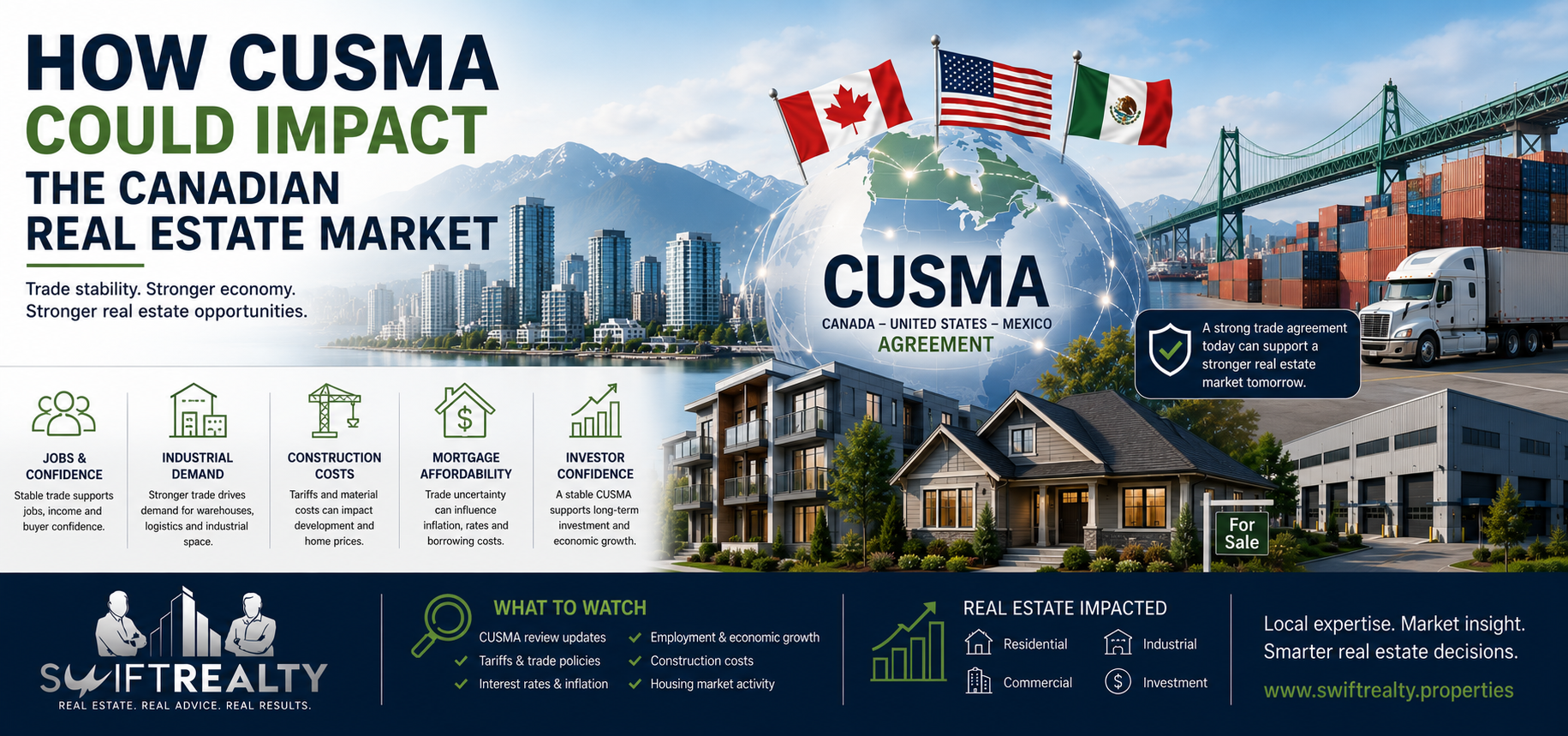
TL;DR: CUSMA does not directly set Canadian real estate prices, but it can affect the economy behind the market. Trade stability can influence jobs, business confidence, industrial demand, construction costs, mortgage affordability, and investor decisions.
The upcoming CUSMA review could have a significant impact on the Canadian economy and the real estate market.While CUSMA is primarily a trade agreement among Canada, the United States, and Mexico, it can also affect housing demand, commercial real estate, industrial properties, mortgage affordability, and investor confidence.
At Swift Realty, we monitor economic changes that may affect homeowners, buyers, sellers, landlords, tenants, and real estate investors across Vancouver, North Vancouver, West Vancouver, Burnaby, Surrey, Coquitlam, and the Lower Mainland.
What Is CUSMA?
CUSMA stands for the Canada-United States-Mexico Agreement. It replaced NAFTA and came into force in 2020. The agreement helps manage trade between Canada, the United States, and Mexico.
The agreement affects many industries, including manufacturing, transportation, construction, energy, agriculture, technology, and logistics.
Because these industries support jobs and business growth, CUSMA can indirectly affect the Canadian housing market and commercial real estate market.
Why CUSMA Matters To Real Estate
Real estate is connected to the overall economy.
When trade is stable, businesses may feel more comfortable investing, hiring, expanding, and leasing space. That can support buyer confidence, rental housing demand, industrial space demand, and long-term property investment.
Global Affairs Canada says CUSMA reinforces Canada's economic ties with the United States and Mexico and supports trade across North America. The agreement is also being reviewed in 2026.
Impact On Residential Real Estate
A stable trade agreement can support employment and confidence in income.
When people feel secure in their jobs, they may be more likely to purchase homes, upgrade properties, or invest in real estate.
This can affect the Vancouver real estate market, North Vancouver homes for sale, West Vancouver real estate, and housing demand across the Lower Mainland.
If trade uncertainty increases or if tariffs affect Canadian businesses, some buyers may become more cautious. This could influence housing activity, especially in markets where affordability is already a concern.
Impact On Commercial Real Estate
CUSMA can also affect commercial real estate in Canada.
Businesses that rely on cross-border trade may need offices, warehouses, retail spaces, and industrial properties.
A stable CUSMA agreement may support demand for:
Office space
Warehouses
Distribution centres
Industrial properties
Retail locations
Investment properties
For real estate investors, this matters because business confidence often supports demand for commercial and industrial properties.
Industrial Real Estate And Warehousing Demand
One of the biggest real estate impacts could be in industrial real estate.
Cities such as Vancouver, Toronto, Calgary, and Montreal are important logistics and trade hubs. In Metro Vancouver, industrial properties are already in high demand.
If CUSMA supports stronger trade between Canada and the United States, demand for warehouses, storage facilities, distribution centres, and logistics space may continue to grow.
This could be especially important for investors looking at commercial real estate in Vancouver, industrial real estate in the Lower Mainland, and long-term income-producing properties.
Impact On Mortgage Rates And Affordability
Trade uncertainty can affect inflation and borrowing costs.
If tariffs increase the price of construction materials, vehicles, equipment, or imported goods, inflation may rise. Higher inflation can influence interest rates, which in turn affect mortgage payments and housing affordability.
For buyers and homeowners in British Columbia, mortgage affordability remains one of the most important factors in the market.
Impact On Real Estate Investors
For real estate investors, CUSMA matters because it can affect business confidence and long-term economic growth.
A stable trade agreement may support:
Rental property investment
Multi-family real estate
Commercial real estate
Industrial properties
Long-term property planning
Investor confidence in Canada
This does not mean CUSMA will determine property values on its own. It is one factor among others in a larger market that also includes interest rates, population growth, housing supply, employment, and local policy.
What Should Buyers And Sellers Watch?
Over the next few months, Canadian homeowners, buyers, sellers, and investors should watch:
CUSMA review updates
U.S. tariff policies
Interest rate changes
Canadian employment numbers
Inflation trends
Construction costs
Business investment in Canada
Housing market activity in Vancouver and the Lower Mainland
The Bank of Canada has noted that the CUSMA review poses a risk to the economic outlook, with several possible outcomes depending on how it unfolds.
What This Means For Your Next Real Estate Decision
CUSMA may not directly control real estate prices, but it plays an important role in Canada's economy. A stable trade agreement can support jobs, business growth, investment confidence, and housing demand.
For anyone involved in the Canadian real estate market, including homeowners, first-time buyers, landlords, tenants, and investors, it is worth understanding how trade policies can influence the market.
If you are thinking about buying, selling, renting, or investing in British Columbia, Swift Realty can help you consider how local trends and broader economic shifts may affect your next move.


Responses